

AI Agent vs Chatbot: What Is the Difference and Which Do You Need?
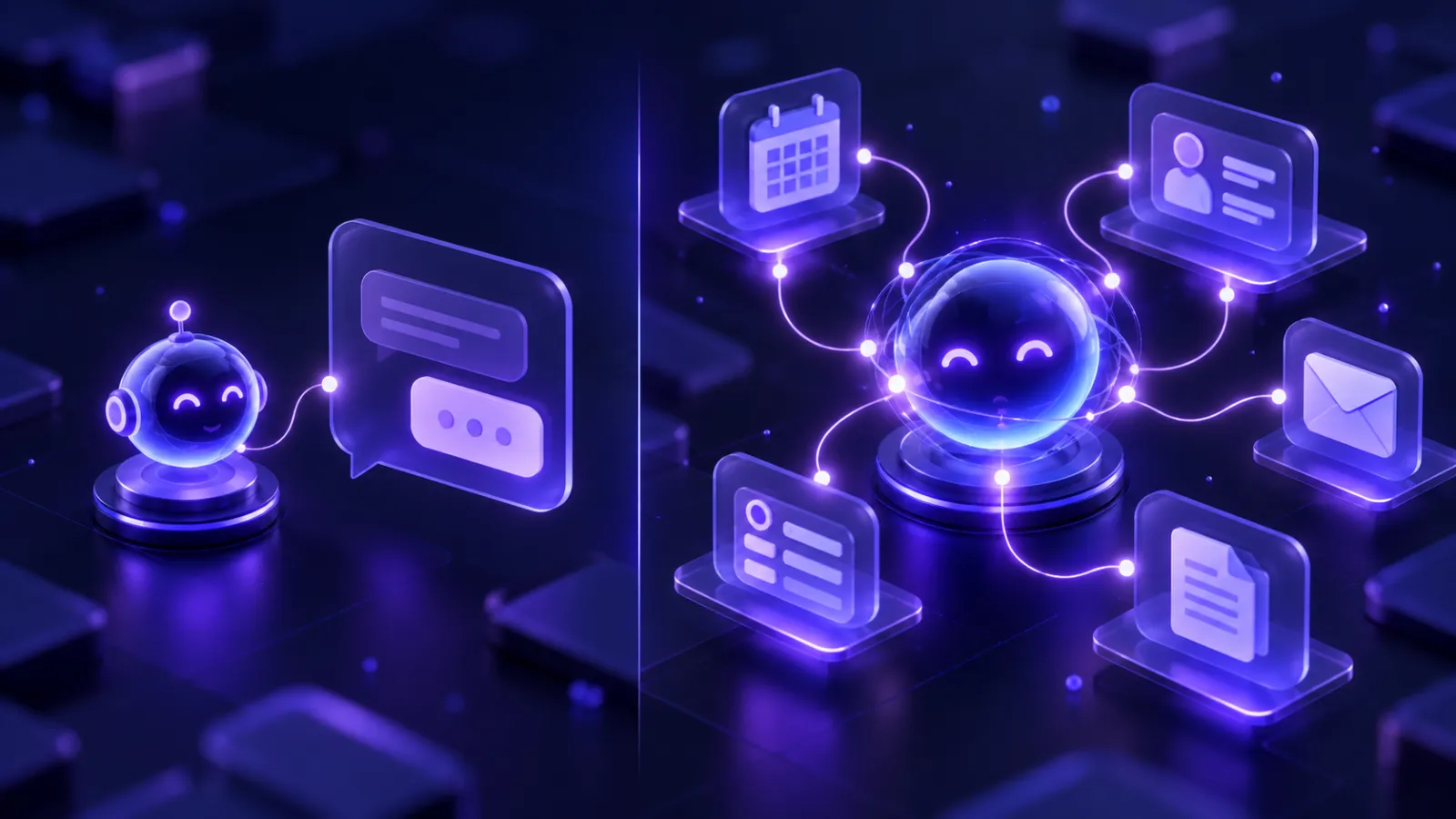
The terms “chatbot” and “AI agent” are often used interchangeably, but they describe different things. Choosing the right one affects what you can automate, how much you spend and how much risk you take on.
The Short Answer
A chatbot holds a conversation and answers questions. An AI agent can hold a conversation too, but it can also decide on and take actions across your systems to complete a task. Every useful agent can chat; not every chatbot is an agent.
Side-by-Side Comparison
- Goal — Chatbot: answer the question. Agent: complete the task.
- Actions — Chatbot: mostly replies, maybe collects details. Agent: updates records, sends messages, books, creates documents.
- Steps — Chatbot: single turn or scripted flow. Agent: plans and executes multi-step work.
- Integrations — Chatbot: few, often read-only. Agent: many, read and write.
- Risk — Chatbot: low; wrong answers are the main risk. Agent: higher; needs permissions, approvals and audit logs.
- Cost — Chatbot: lower to build and run. Agent: higher, but replaces more manual work.
When a Chatbot Is Enough
If your goal is to answer common questions — timings, prices, eligibility, directions — and capture enquiries for your team, a modern AI chatbot on your website or WhatsApp is usually the right, lower-cost choice.
When You Need an AI Agent
If your team spends time acting on those conversations — checking systems, updating records, sending documents, scheduling — an agent can do that work too. Typical examples include order changes, appointment booking with calendar checks, lead qualification with CRM updates, and processing documents.
A Practical Path
Many businesses start with an AI chatbot, learn which questions and requests come in most often, and then upgrade the high-volume requests into agent actions. That keeps the first investment small and lets real data decide what to automate next.
Real Examples From Indian Businesses
- Coaching institute — a chatbot answers fee, batch and syllabus questions; an agent also books the demo class, updates the CRM and assigns a counsellor
- Clinic — a chatbot shares timings and doctor availability; an agent checks the live calendar, books the slot and sends a WhatsApp reminder
- D2C brand — a chatbot answers return policy questions; an agent verifies the order, creates the return pickup and issues the refund for approval
- Real estate — a chatbot sends brochures; an agent qualifies budget and timeline, schedules the site visit and alerts the sales executive
Questions to Ask Before You Decide
If most conversations end with a simple answer, start with a chatbot. If most end with a task for your team, an agent will save far more time.
- How many conversations a week lead to someone on your team doing manual work afterwards?
- Which systems would the AI need to read from or write to?
- What is the cost of a mistake, and which actions must a human approve?
- Do you have clear, up-to-date information the AI can learn from?
Cost Comparison in India
A well-built AI chatbot for a website or WhatsApp typically costs ₹40,000–₹2,00,000 to set up. An AI agent that works across your CRM, calendar or order system usually costs ₹1,00,000–₹10,00,000 depending on the number of integrations and safeguards. In both cases, monthly running costs depend mainly on conversation volume.
Can a Chatbot Grow Into an Agent?
Yes — and that is often the smartest path. If your chatbot is built on a modern language model with a proper knowledge base, adding agent capabilities later mostly means connecting tools: your calendar for booking, your CRM for updating leads, your order system for returns. The conversation layer stays the same while the assistant gradually takes on more work.
Plan for this from day one by choosing a platform that supports tool integrations, keeping your business data clean and accessible, and logging every conversation so you can see which requests are worth automating next.
Key Takeaways
- Chatbots answer; agents complete tasks
- Start with a chatbot if most conversations end with an answer
- Choose an agent when conversations create manual work
- Build on a platform that can grow from one to the other
Frequently Asked Questions
Is an AI chatbot the same as an AI agent?
No. An AI chatbot focuses on conversation and answers. An AI agent can also take actions in other systems to complete tasks.
Which is cheaper, a chatbot or an AI agent?
Chatbots are cheaper to build and run. Agents cost more but can replace more manual work, so the better value depends on the tasks involved.
Related Reading & Services
Want Help Putting This Into Practice?
Talk to our Hyderabad team about your project — free consultation, no obligation.